A mobile maintenance companion for embassy engineers.
Technicians recorded work on paper or from memory, then returned to a desk to enter it. Across 45 interviews, standardization emerged as the widespread problem and battery tracking became the team's concrete starting point.
- Role
- UX strategy, discovery research, product design
- Period
- February–June 2025
- Evidence
- 45 stakeholder interviews
- Build
- Power Apps + Dataverse MVP
The project in 30 seconds
Maintenance happened away from the system of record, so technicians depended on paper, memory, and later data entry.
Forty-five interviews showed that inconsistent records were widespread, with battery tracking standing out as a common frustration.
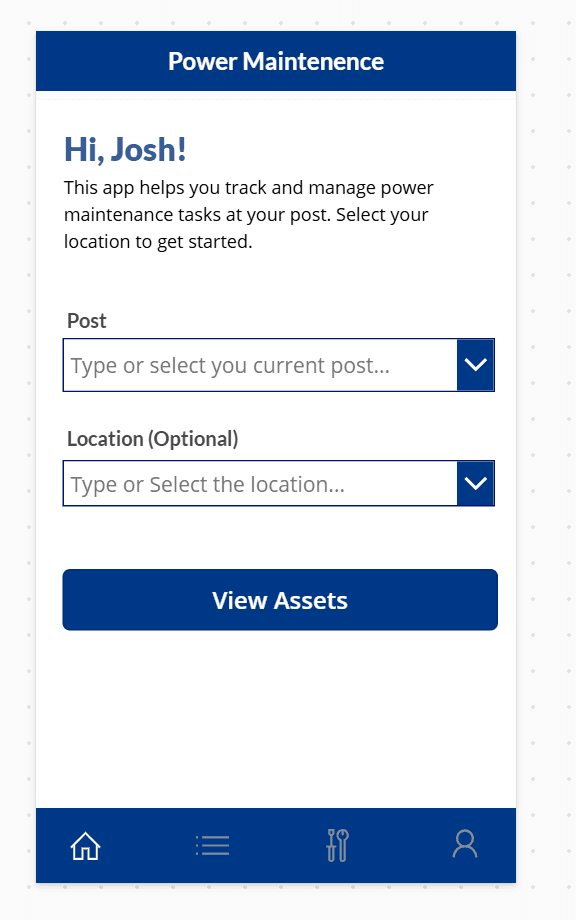
A Power Apps companion for selecting a post, viewing assets, and logging structured battery-maintenance data on site.
Maintenance happened in the field. The record waited at the desk.
A typical Security Engineering Officer travels between posts, inspects assets and non-assets, takes notes on paper, and later returns to a workstation to enter the data. The delay made it harder to know what required attention before the technician arrived.
Design question How could technicians capture structured maintenance data at the point of inspection without introducing an unapproved platform?
Standardization was the dominant issue
Across 45 interviews, inconsistent maintenance records emerged as the most important problem in the process.
Batteries exposed the tracking gap
Batteries were a common frustration and were often not tracked because they fell below the $500 asset threshold.
Problems were discovered too late
Technicians could arrive at a post before learning that a part needed attention, delaying work orders and replacement orders.
Testing changed the product from reactive work orders to proactive maintenance.
The first concept focused on managing work orders in the field. Early validation showed that similar work was already underway, and that technicians needed to know what required attention before something failed.
Help technicians manage tasks after an issue was already known.
Technicians needed visibility before a visit, not another surface for work already assigned.
Record condition and attention states during inspections to build a proactive history.
The checklist became useful when attention states moved to the asset list.
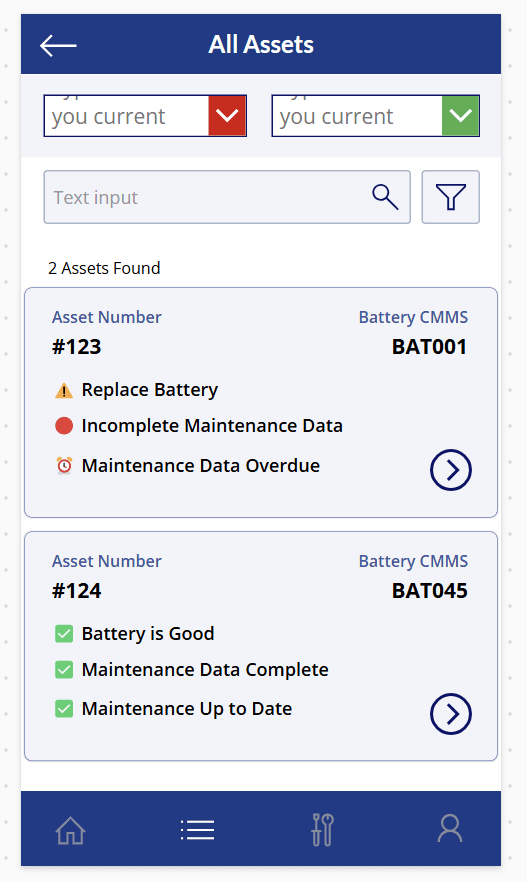
Early screens showed a general status. The sketch and revised interface surfaced missing data, overdue maintenance, and battery condition before a technician opened the full record.
Three decisions translate the interview findings into the MVP.
Each decision connects a documented field problem to a specific product response.
Replace paper and memory with field entry
Paper notes and later re-entry created delay, inconsistency, and missing detail.
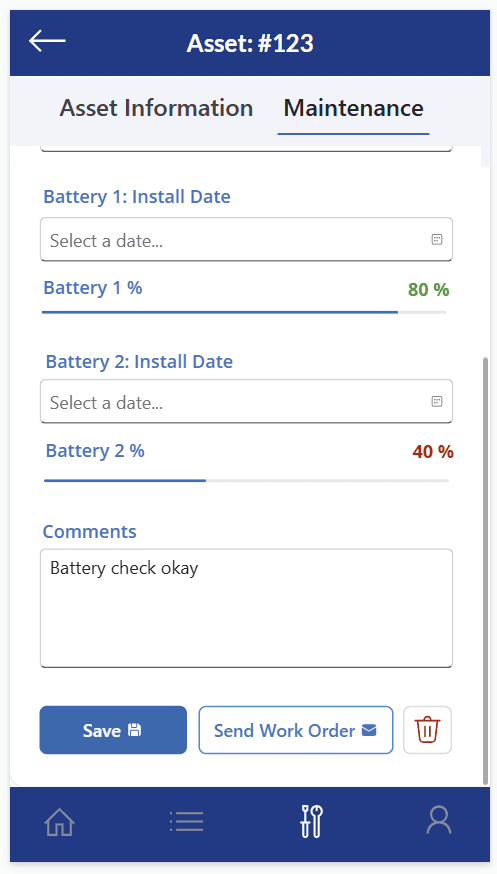
The mobile checklist records voltage, installation dates, serial information, and observations during the inspection.
Make the next maintenance need visible
Technicians lacked a simple way to see which assets and non-assets required attention before arriving at a post.
Post, location, asset, and attention states are brought into one mobile view so the technician can prepare earlier.
Start with the overlooked battery routine
A solution for every maintenance category would be too broad for the first implementation, while batteries had a repeated and documented tracking gap.
The team used battery inspections as a concrete starting point, built in Power Apps with structured data stored through Dataverse.
The functional MVP turns one inspection into a reusable record.
The final flow moves from post selection to asset status, then into the information and maintenance fields for a specific battery.
- 01SelectChoose the post, location, and asset
The app narrows the technician's context before showing the relevant maintenance record.
- 02InspectRecord the battery condition
The checklist captures voltage, battery percentage, installation dates, comments, and follow-up needs.
- 03SaveCreate a dated maintenance history
A completed entry can be saved for later review, while urgent findings can initiate a work-order handoff.
The full flow shows how one field check becomes a maintenance record.
The overview connects post selection, asset status, equipment information, battery condition, comments, and work-order escalation in one sequence.
The MVP earned interest for a field pilot.
Validation with the primary beneficiary and multiple Security Engineering Officers led to continued rollout conversations while the checklist-based MVP was refined for field readiness.
These are projected estimates based on sponsor discussions and field validation, not measured production results.
“I really hope we can get this done and continue development of more apps based on the refined interface.”
Officer-in-Charge, Engineering Services Office, U.S. Embassy Vienna
The strongest move was choosing a tractable starting point.
“Field maintenance” was too broad to design as one undifferentiated problem. The interviews made it clear that the shared need was standardized mobile records, while the battery workflow gave the team a specific routine to build and a future pilot something concrete to evaluate.